– Article in partnership with Huawei –
The transformation of the financial sector is no longer about simple digitalization, but about evolving toward intelligent systems capable of learning, predicting, and adapting. Today’s real competitive advantage lies in the ability to connect data, people, and decisions through contextual technologies. At GITEX 2025 in Dubai, Huawei and its global partners explored this future with the Global Financial Partner Ronghai program, which demonstrates how collaboration, data convergence, and artificial intelligence are already delivering concrete results—laying the foundation for a new era of institutional finance.
Summary
The Shift Reframing the Financial Transformation
The financial industry is entering a new phase where intelligence, not just digitization, defines progress. Institutions are moving beyond process automation to build systems that can think, predict, and act in real time.
Across markets, the convergence of AI, data, and automation is reshaping how decisions are made, risks are managed, and customer value is created. Financial institutions are adopting data-driven models that enhance adaptability and resilience — essential qualities in a landscape where uncertainty has become the norm.
Within this transformation, Huawei is emerging as a strategic technology partner, helping banks and financial entities transition from traditional digital frameworks to intelligent, sustainable operations. By aligning advanced infrastructure with AI capabilities and strong data governance, Huawei supports institutions in modernizing their foundations while preparing for the next stage of intelligent finance.
The Ronghai Program embodies this vision — a catalyst for collaboration that connects technology, expertise, and innovation to accelerate the intelligent evolution of institutional finance.
Institutional Fintech Shaping the Architecture of Modern Finance
The rise of institutional fintech marks a turning point in how regulated financial entities approach modernization. Unlike the early wave of consumer-oriented fintechs, this new generation of solutions focuses on the core of financial infrastructure — helping banks, insurers, and regulators strengthen their systems while remaining compliant and resilient. It is not disruption, but intelligent reinforcement.
At the center of this evolution lies the convergence of AI, cloud, and big data. Together, they are redefining how institutions build operational resilience, ensure regulatory transparency, and deliver faster, more contextual financial services. AI supports real-time decision-making; cloud ensures scalability and security; and data integration brings consistency to compliance and reporting. This triad forms the foundation of a new financial architecture designed for intelligence and trust.
A clear example of this transformation comes from TrustDecision, one of the Ronghai partners. Its Decision Engine, deployed on Huawei Cloud, acts as the analytical core for financial institutions seeking speed and accuracy in credit and fraud detection. By combining AI-driven insights with Huawei’s data infrastructure and regional compliance capabilities, TrustDecision enables financial entities to make faster and smarter decisions — all while maintaining the governance and security standards required in regulated finance.
This approach demonstrates how institutional fintech is not replacing traditional systems but enhancing them by transforming stability into intelligence and compliance into capability.
From Architecture to Ecosystem The Rise of the Ronghai Vision
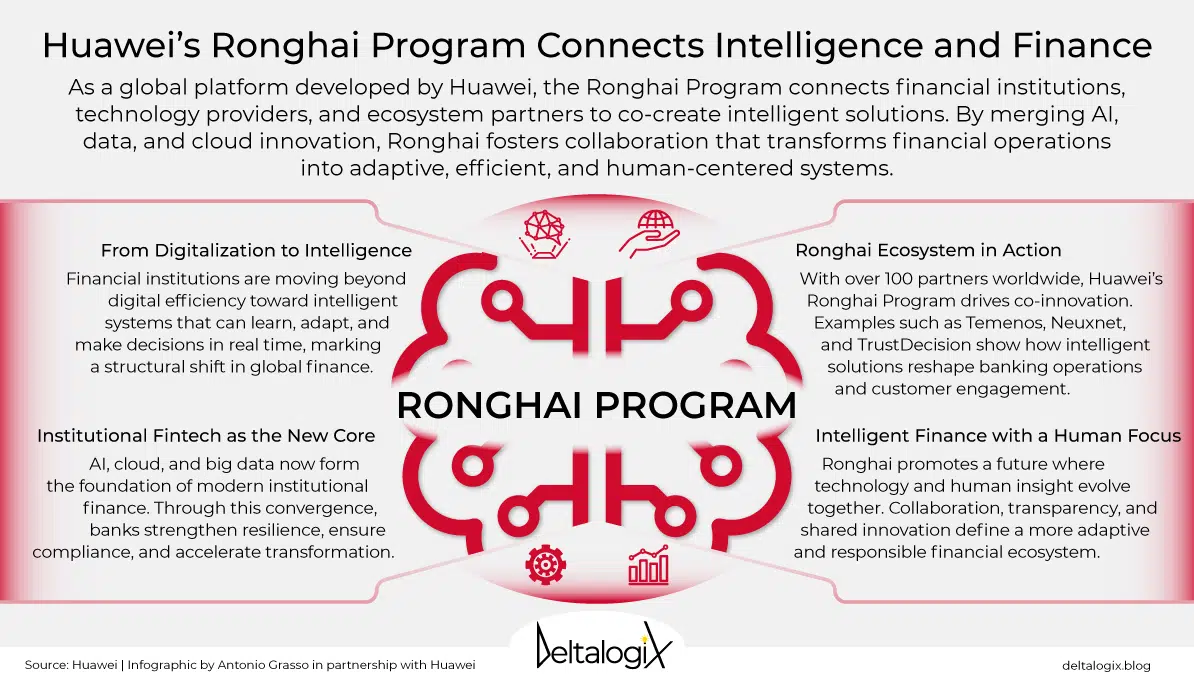
When Huawei introduced the Global Financial Partner Ronghai Program at Huawei Connect 2024, it marked the beginning of a new chapter in financial collaboration. The vision behind Ronghai is clear — to build an open, intelligent ecosystem where technology and expertise converge to accelerate the digital and intelligent transformation of the global financial industry. It is not a framework of alliances, but a living network of co-innovation.
Over the past year, the program has evolved into a platform that connects partners, customers, and institutions across regions. Through initiatives such as the Ronghai Solution Salon, Huawei has created a space for dialogue and experimentation where financial institutions and technology providers jointly explore new AI-driven solutions. This approach allows real collaboration to happen — not around theoretical concepts, but around working models that address real-world challenges.
The results are already visible through Huawei’s growing ecosystem of partners. Temenos, a global banking software provider, is leveraging Huawei’s native cloud capabilities to power its AI copilots and automation tools for next-generation banking. These solutions bring operational intelligence into daily banking processes, improving efficiency and compliance.
Neuxnet, another Ronghai partner, is creating AI-driven workforce platforms that enhance enterprise productivity and operational agility, illustrating how AI can move from process support to real business empowerment.
Through these collaborations, the Ronghai Program demonstrates measurable progress — transforming the idea of partnership into an active mechanism for innovation, showing that the path toward intelligent finance is not theoretical, but already taking shape through joint development, shared expertise, and trust built within the ecosystem.
Huawei’s Ronghai program showcases a new model of collaboration that brings together innovation and execution, transforming collective expertise into real results. Share on X
Intelligence as the Engine of Transformation
The evolution of finance is no longer defined by operational efficiency alone. What once centered on speed and cost reduction has now expanded into a broader goal — building systems that can adapt, learn, and evolve. In this new context, efficiency is not the destination but the starting point for structural transformation.
Huawei’s approach reflects this shift. By integrating AI, data, and infrastructure into a unified framework, the company enables financial institutions to move from incremental optimization to continuous reinvention. This integration creates what can be described as adaptive capability — the ability of systems to respond intelligently to change, manage complexity, and generate new forms of value.
An example of this transformation can be seen in Neuxnet’s AI workforce solutions, developed within the Ronghai ecosystem. Designed to augment rather than replace human work, these AI employees automate repetitive tasks, streamline operations, and free professionals to focus on higher-value decisions. The result is not only increased productivity but a reconfiguration of how work itself is organized and executed within financial institutions.
This evolution illustrates Huawei’s broader vision of intelligent finance — a landscape where technology does not simply make existing processes faster, but enables a new structure of resilience, learning, and growth.
Huawei and the Ronghai Program for Intelligent Finance
The transformation unfolding in the financial industry is not only technological but structural. The institutions that lead this new era are those that understand intelligence as an ecosystem, a dynamic relationship between data, infrastructure, and human capability. The future of finance will depend on how effectively these elements can interact, learn, and grow together.
This is precisely where Huawei’s Ronghai Program stands out. It represents a new model of collaboration that connects innovation with execution, turning collective expertise into measurable progress. By expanding its network of partners and nurturing cross-disciplinary cooperation, the program has built a foundation where intelligent finance can thrive responsibly, balancing innovation, compliance, and sustainability.
Through these collaborations, Huawei demonstrates that intelligence is not a destination, but a continuous process of co-creation that connects people, data, and technology. This approach reflects a wider shift in finance — one that sees intelligence not as an add-on but as a guiding principle shaping every interaction.
In the same way that this transformation began at the intersection of finance and technology, it now advances through collaboration, purpose, and human insight, showing that progress in finance is no longer just about digital tools, but about the capacity to learn and grow together.
- Original article previously published here.